Your Coffee Deserves Better Than Being a Productivity Tool
At some point in the last decade, coffee in America stopped being a drink and became a delivery mechanism. The rise of the 32-ounce cold brew, the pre-workout espresso, the mid-afternoon pick-me-up — all of it framed not around pleasure but around performance. We don't enjoy coffee anymore. We deploy it.
The language alone gives it away. Fuel up. Power through. Get a boost. Your morning cup has been conscripted into the hustle economy, and it's been stripped of everything that made it worth drinking in the first place.
Meanwhile, in a small café in Naples, a man in a pressed shirt is standing at a zinc bar. He has ordered a caffè — a tiny, intensely concentrated espresso that will be gone in three sips. He is not checking his phone. He is not reviewing his calendar. He is drinking his coffee. That's the whole thing. That's the entire activity.
The Ritual vs. The Refuel
European coffee culture didn't develop around the idea of consumption for efficiency. It developed around the café as a social and civic institution — a place where you paused your day, encountered other humans, and participated in something slightly larger than your own to-do list.
In Vienna, the Kaffeehäuser tradition dates back to the 17th century. These were places where intellectuals, artists, and ordinary citizens sat for hours with a single cup, reading newspapers, debating ideas, or simply existing in companionable public space. The coffee was almost incidental. The point was the pause.
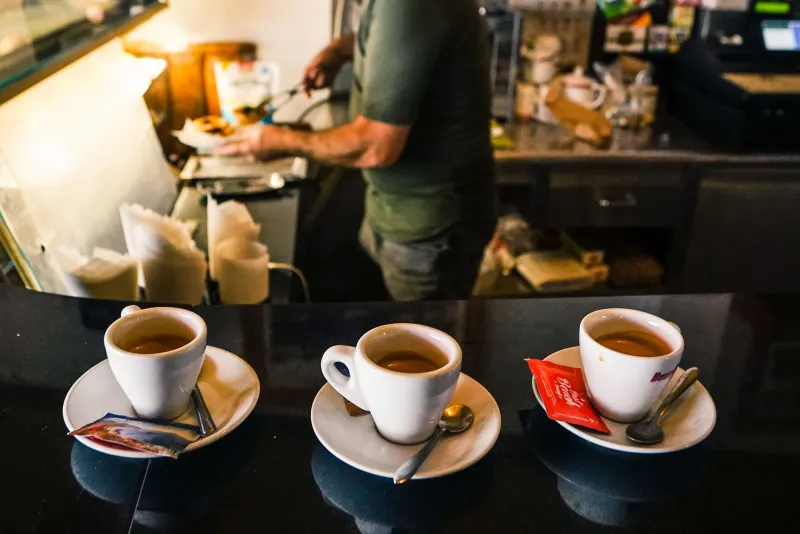
In Italy, the espresso bar is a neighborhood institution. You stop in on your way to work, exchange a few words with the barista who knows your order, drink your coffee standing up (sitting costs more and is frankly beside the point), and continue on your way. The whole thing takes four minutes. But those four minutes are yours — a small, intentional break in the forward momentum of the day.
In France, un café arrives in a demitasse with a small square of chocolate or a glass of water. You don't rush it. Rushing it would be rude — to the coffee, to yourself, to the experience of being a person in the world.
None of this is about caffeine optimization. All of it is about presence.
What Productivity Culture Did to Your Palate
Here's a thing worth sitting with: when coffee becomes fuel, you stop tasting it. You start drinking it at a volume and speed that makes the nuance irrelevant. A 20-ounce drip coffee with three pumps of vanilla syrup, consumed while merging onto the freeway, is not a coffee experience. It's a caffeine delivery system wearing a paper cup.
This isn't snobbery — it's just physics. You cannot taste something you're inhaling. You cannot appreciate a ritual you're performing on autopilot.
Specialty coffee culture in the US has made genuine strides toward reclaiming some of this — the third-wave cafés, the single-origin pour-overs, the ceramics and the careful water temperature. But even there, the language often defaults to performance. This Ethiopian natural process has notes of blueberry and will absolutely destroy your afternoon slump. The pleasure is still framed as a means to an end.
Europeans, broadly, have not fallen into this particular trap. Not because they're immune to busyness — anyone who's navigated a German train schedule or a Parisian workday knows that's not true — but because coffee exists in a category that productivity hasn't fully colonized yet. It's still, culturally, a pleasure. A small one, but a real one.
The Neuroscience of Slowing Down to Speed Up
There's actually something to be said for the European approach beyond aesthetics. Research on attention and focus consistently shows that brief, intentional breaks — the kind where you're genuinely disengaged from task-focus — restore cognitive resources more effectively than pushing through. A four-minute espresso at a café bar, where you're doing nothing but drinking coffee and existing, is functionally a reset.
The American version of a coffee break — scrolling Instagram while drinking a cold brew at your desk — is not a break. It's just a different kind of stimulation layered on top of your already-stimulated nervous system.
The Europeans stumbled onto something that neuroscience is only now formally articulating: doing one thing at a time, even something small, is restorative. The coffee isn't the point. The pause is the point. The coffee just gives you a socially acceptable reason to take it.
How to Reclaim Your Morning Cup
You don't have to move to Rome. You don't need a €400 espresso machine or a subscription to a single-origin roaster in Portland. You need to decide, once, that your coffee is going to be a moment and not a task.
Some practical entry points:
Make it smaller. A six-ounce cup of really good coffee, made with attention, beats a giant travel mug of mediocre coffee consumed in transit. Smaller means you actually finish it while it's hot. Smaller means it has to be good, because there isn't much of it.
Make it still. No scrolling. No emails. No podcast. Just coffee. Even five minutes of this feels radical at first, which tells you something important about how depleted your attention actually is.
Make it social when you can. The café tradition isn't just about the coffee — it's about the brief human contact that punctuates the day. A regular spot, a familiar face, a few exchanged words. This is not inefficiency. This is what being a person feels like.
Drink it where you made it. Or where someone made it for you. Sit down. Look out the window. Be there.
The Bigger Thing Under the Coffee
The European relationship with coffee is really a proxy for something larger: a cultural insistence that not every moment needs to be optimized, that pleasure is a legitimate end in itself, and that presence — actual, ungimmicked presence — is worth protecting.
America has been running on fumes for a while, mistaking stimulation for energy and busyness for purpose. Coffee has become a metaphor for all of it: something that should be savored, turned into something to survive on.
Your morning cup doesn't have to fix that. But it can be a small daily practice of choosing differently. Of saying, for these four minutes, I am not a productivity unit. I am a person, drinking something good, and that is enough.
The Neapolitans have known this for centuries. The espresso, after all, is not called a fast — it's called an express. The point was never the speed. The point was the essence.