You Spent Forty-Five Seconds Looking at That Painting. Here's What You Missed.
I watched a family move through the Impressionist rooms at the Art Institute of Chicago once. They were doing a respectable job — pausing, pointing, occasionally reading the wall text. But they were also, very clearly, completing the museum. There was a pace to it, a momentum, a sense that the goal was coverage. They had come to see the paintings, and they were seeing them, and when they had seen enough of them they would go to the gift shop and then get lunch.
I'm not here to be snobbish about this. I've done it. We've all done it. The museum as checklist is a deeply American way of engaging with cultural institutions, and it makes a certain kind of sense — you paid for the ticket, you drove downtown, you found parking, you might as well see the whole thing.
But there's another way to be in a museum. And it looks almost nothing like this.
The European Museum as Habit
In many European cities, the museum is not an event. It's a place you go the way you go to a park or a café — not to complete it, but to spend time in it. The Louvre is enormous and overwhelming and nobody is expected to see all of it in an afternoon. The Uffizi in Florence has a permanent collection that Florentines visit repeatedly throughout their lives, each time noticing something new.
This is partly structural. European museums are often cheaper, sometimes free for residents, and located in city centers where they're genuinely accessible. But the habit runs deeper than economics. There's a cultural understanding that art is not a one-time experience — that a painting you've stood in front of ten times is a different painting than the one you saw for the first time at seventeen.
Repeat visits are not redundancy. They're how art actually works.
What Slowing Down Actually Does
Here's the practical case for spending more time in front of less. When you stand in front of a painting for five minutes instead of forty-five seconds, something happens neurologically and emotionally that simply cannot happen in forty-five seconds.
You start to see the painting rather than recognize it. You notice the way the light falls in the upper left corner. You register the expression on the face in the background that you'd missed entirely on the first pass. You start to have a relationship with the work — not an intellectual one necessarily, but a sensory, felt one. The painting stops being an object you've encountered and starts being an experience you're having.
This is what contemplation looks like. It's not passive. It's deeply active, in the way that listening carefully to someone is active even though you're not speaking.
Tourism vs. Engagement
American travel culture has a complicated relationship with the difference between going somewhere and experiencing somewhere. We're very good at the former. We plan itineraries, research the must-sees, hit the highlights with impressive efficiency. What we're less practiced at is the kind of aimless, unhurried presence that turns a trip into something that actually changes you.
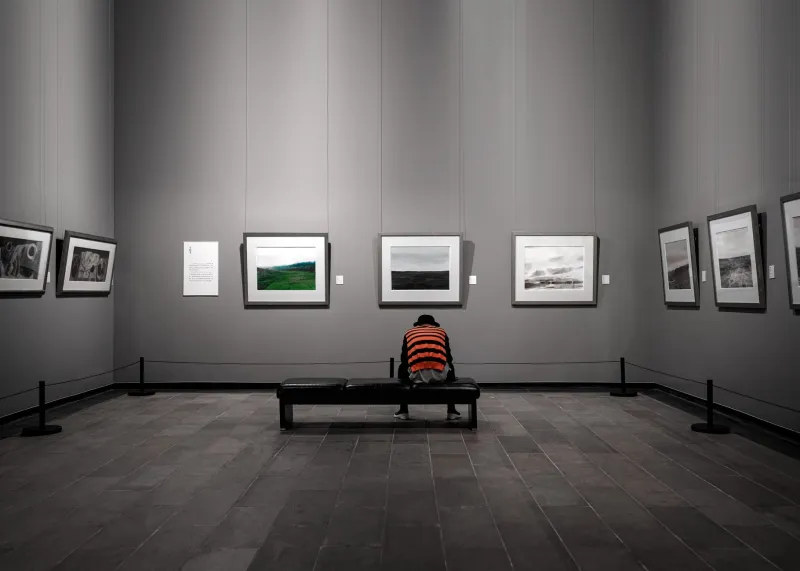
The same applies to museums. Tourism in a museum looks like covering the collection. Engagement looks like sitting on a bench in front of one painting for twenty minutes because something about it won't let you go.
Engagement is rarer and less photogenic and harder to describe when someone asks what you did at the museum. But it's the version that stays with you. The version you think about on the subway two weeks later. The version that quietly rewires something about how you see.
The Bench Is Not a Defeat
There's a specific thing that happens in European museums that I find quietly radical: people sit down and look. Not because their feet hurt (though that too). Because sitting is a legitimate way to be in a museum. The bench in front of a painting is not a place to rest between paintings — it's a place to be with a painting.
I've sat for a long time in front of Vermeer's Girl with a Pearl Earring in The Hague. I've spent an entire morning in a single room at the Musée d'Orsay. I've watched other visitors do the same — not the tourists rushing through, but the regulars, the locals, the people who come back. They look comfortable. They look like they belong there. Because they do.
You belong there too. You don't have to earn the right to linger by first completing the rest of the museum.
How to Actually Do This
If you want to try the European approach to museum-going, here's the only instruction you need: go with less ambition.
Pick three rooms, or one. Give yourself permission to not see the whole thing. Choose one work that you'll spend real time with — not because it's famous, but because something about it stops you. Read about it afterward if you want, but sit with it first, without the context. Let it be strange or beautiful or confusing before you let it be explained.
Come back. That's the real move. Come back to the same museum in a different season, in a different mood, at a different point in your life. You'll be surprised how much the paintings change when you do.
What You Were Looking For All Along
The rush through the museum is, in a way, a form of anxiety — the fear that you'll miss something, that you won't have gotten enough, that the experience won't be worth what it cost. It's the same anxiety that makes us scroll faster, consume more, move on before we've finished arriving.
The antidote, as usual, is attention. Not more content but more presence with the content you already have.
That painting has been waiting for you for a long time. It can wait a little longer while you actually look at it.