Rooms Nobody Lives In: The American Housing Trap Europeans Quietly Avoid
Let me tell you about the dining room in the house I grew up in. It had a mahogany table that seated eight, a chandelier that was always slightly too dim, and a carpet that had never, in my entire childhood, been walked on without shoes. We ate in there maybe four times a year. Thanksgiving. Christmas. The occasional birthday dinner when my mother wanted to feel like someone was watching. The rest of the time, it just sat there. Waiting for a formality that rarely came.
This is not unusual. This is, in fact, the defining feature of how Americans build homes — and it's worth asking why.
The Room That Exists in Theory
The American obsession with dedicated rooms is partly historical, partly aspirational, and almost entirely disconnected from how most of us actually spend our days. The formal living room. The dining room. The home office that doubles as a guest room and a storage unit for things we don't know what to do with. These spaces are purchased as symbols of arrival — proof that you have enough house to have rooms you don't need.
European residential design, particularly in cities like Paris, Copenhagen, Amsterdam, and Milan, has never had the luxury of that kind of symbolic square footage. And what looks like a constraint from the outside turns out to be, in practice, a form of clarity. When you can't afford to dedicate 200 square feet to a table that gets used four times a year, you start designing around what actually happens in a home.
What actually happens in a home, it turns out, is mostly this: people eat where they're comfortable, work where the light is good, and gather in whatever room feels warm. The rest is theater.
Flexibility as Philosophy
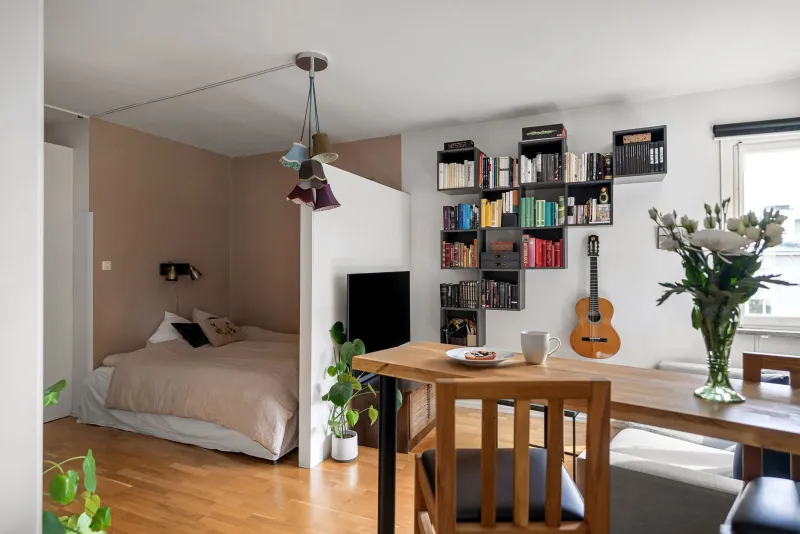
The European apartment — and I'm speaking broadly here, because the continent contains multitudes — tends to operate on the principle of the multi-functional room. A dining table is also a work surface. A living area can absorb guests overnight. The kitchen is often the social center of the home rather than a separate utility room hidden from view.
This isn't just clever spatial problem-solving. It's a fundamentally different relationship with domestic space. European homes are designed to be used, not staged. The kitchen in a Parisian apartment is rarely a showroom of appliances nobody touches; it's a working room with evidence of recent cooking, a small table where someone had their coffee this morning, and a window that matters.
The American open-plan trend of the last two decades tried to borrow this energy. Knock down the wall between the kitchen and the living room, let the spaces flow, make it feel European. And it's not wrong, exactly. But it's only half the lesson. The other half is about subtraction — about refusing to add rooms just because a real estate listing makes them sound desirable.
What the Square Footage Is Actually For
Here's the part that gets uncomfortable: a lot of American housing square footage exists to impress people who don't live there. The formal dining room is for guests. The living room with the untouchable furniture is for guests. The guest room that sits empty 340 days a year is, obviously, for guests.
Europeans are not less hospitable. Anyone who has been welcomed into a Dutch home or sat around a long Italian table knows that. But European hospitality tends to happen in the spaces where life already occurs — not in rooms that have been held in reserve for the performance of domesticity.
There's something psychologically significant about this. When your home is designed around real life rather than imagined life, you actually inhabit it differently. You feel less like a guest in your own house. You stop saving the good candles for a special occasion that never quite arrives.
The Apartment That Taught Me Something
I spent a few weeks in a friend's apartment in Lisbon a couple of years ago. It was maybe 700 square feet for two people, with a kitchen that opened directly onto a living space, a small bedroom, and a balcony just large enough for two chairs and an argument. There was no dining room. There was a table — a beautiful, scarred wooden thing — that was used for everything: dinner, work, card games, wrapping presents, spreading out maps.
It was one of the most livable spaces I've ever been in. Not because it was luxurious, but because every inch of it was for something. Nothing was held in reserve. Nothing was waiting for a better occasion.
I came home and walked through my own apartment and noticed, for the first time, how much of it I was barely using.
Building Differently
This isn't a call to move to Lisbon (though, I mean, consider it). It's a nudge toward questioning the assumptions baked into how American homes are designed, sold, and valued.
The next time you're looking at a floor plan and the real estate listing celebrates a "formal dining area" and a "bonus room," ask yourself what those rooms will actually look like on a Tuesday in February. Ask whether you're buying space to live in or space to own. Ask whether the home is designed around your life or around the idea of a life — polished, company-ready, and mostly empty.
Europeans didn't figure this out because they're more enlightened. They figured it out because they had to. But sometimes constraints are the best teachers. And sometimes the room you don't build is the one that sets you free.